By Sanni February 4, 2026
Papaya is one of India’s most promising fruit crops due to its short maturity period, continuous harvesting, and strong market demand. Among the many varieties developed by the Indian Agricultural Research Institute (IARI), Regional Station Pusa, Bihar, Pusa Dwarf stands out as a popular choice for high density planting and quick production.
What is Pusa Dwarf Papaya?
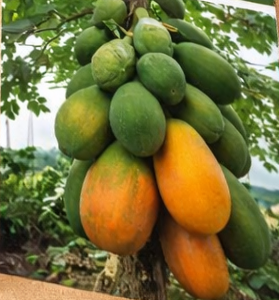
Pusa Dwarf is a dwarf, dioecious papaya variety developed through conventional breeding by IARI scientists. It grows to a compact height and begins fruiting quite close to the ground, making it ideal for intensive cultivation and kitchen gardens.
Key characteristics:
- Dwarf plant stature with early fruiting
- Medium oval fruits, roughly 0.5–1 kg each
- Suitable for high-density planting systems
- Best for smallholder and commercial growers.
Yield & Production Data
Several field reports and crop guides highlight the yield potential of Pusa Dwarf:
Yield per plant: Around 35–40 kg of fruit per plant under good management conditions. This yield is competitive compared to many other papaya types and supports frequent harvesting, as plants can produce fruit continuously once they begin flowering. Because the plant stays compact, farmers can accommodate over 4000 plants per hectare (with spacing like 1.5 m × 1.5 m), making overall per hectare production potentially high even with moderate per plant yields.
Why Farmers Choose Pusa Dwarf
Early Fruiting
Pusa Dwarf starts fruiting at a low height (around 30–40 cm), allowing farmers to harvest sooner than taller papaya types.
Compact Growth
Because of its short stature, this variety fits well in high density plantations and even kitchen gardens. Farmers can plant more trees per unit area, increasing total yield per hectare.
Good Market Demand
Medium-sized fruits with attractive shape and good quality fetch steady prices in local markets. Many growers report faster returns on investment compared to taller or less predictable varieties. (Agribusiness guides note its advantages for small growers)
Economics & Profitability
Although the exact income depends on location, management, and selling price, basic sowing cost is often recovered quickly due to:
- Lower input costs (compact plant needs less space and management)
- Frequent fruiting and harvesting cycles
- Good marketability of medium-sized fruits
Best Conditions for Cultivation
Pusa Dwarf grows well in:
- Warm tropical to subtropical climates
- Well-drained, fertile soils
- Areas with adequate irrigation and balanced fertilization
- Proper spacing, pest management, and nutrient application dramatically influence both fruit quality and total yield.
Conclusion
Pusa Dwarf papaya is a smart choice for farmers seeking early returns, compact growth, and marketability. With yields of around 35–40 kg per plant and suitability for high-density planting, it offers a competitive advantage in papaya production. Supported by research and government policies, this variety can be an excellent crop for both smallholders and commercial growers.